
Wildlife in Kenya is not confined to the parks and reserves alone, though it is generally more abundant in such areas. Although safaris tend to be routed through the reserves, you will often see plenty of wildlife outside.
On an arranged safari you should have little difficulty in recording between 30 to 40 species of mammals and at least 150 bird species. From the reptile family you are likely to see crocodile and quite a few lizards, large and small but you will have to search hard to find a snake despite having a whopping 169 of venomous snakes recorded in east Africa.
Much of the land in Game reserves is a savannah; rich in pasture shaded with tress and its here that the antelope herds are mainly found. A remarkable harmony where several species can graze in the same land, each eating different grasses and herbs and no one species so numerous so as to interfere with the domain of others. Antelopes are notably large and small; the largest – the Eland – weighs in at around 600 kg, a hundred times the weight of the dainty dik-dik.
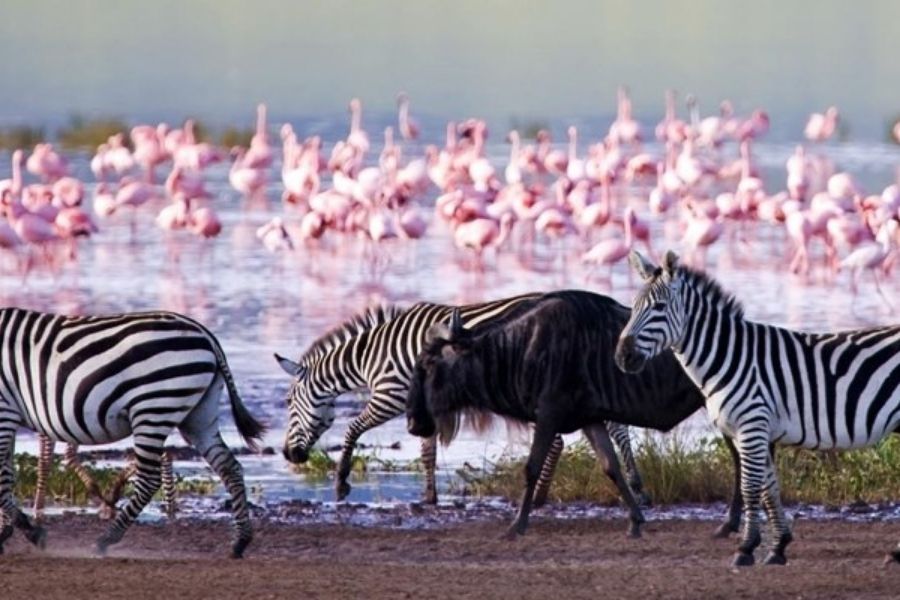
Wildebeest which is among the most numerous of antelopes, share their grazing with Zebra and are naturally gregarious but the smaller antelopes such as the Suni, oribi and Duiker are rarely found in big numbers; indeed, they are almost always solitary or in Pairs. These antelopes commonly inhibit patches of thick cover found in the savannah and some of them, like the duiker have evolved with shorter forelimbs thereby making their dive for cover easier. Duiker means Diver in Afrikaans.
Where there are antelopes, there are also carnivores – Lion, leopard, cheetah, wild dog and hyena, the later as much a hunter in his own right, is however more familiar with the tag of a scavenger. Lion and Leopard are rarely found making a killing in daylight. However not so for the cheetah which need to be able to see to use its principle weapon – the speed.
As a visitor you will also see a range of smaller carnivores – the serval cat, genet and the jackals. Jackals are also predators particularly the beautiful golden-backed (or oriental) species which, again centrally to popular concept, rarely scavenges. Even the most common jackal, the black-backed, finds only one third of its food from scavenging.
But of the predators the average visitors first seek out the lion. But I can promise you that you will likely not be disappointed because the lions are quite common in most of the parks and reserves but nowhere more numerous nor more splendid than in Masai Mara. Lions spends a good deal of the day sleeping or dozing becoming alert in the early evening especially when there is a need to feed.
Lions are remarkably catholic in their tastes. As a whole pride, they kill antelope and Zebra, but warthog,baboon, ostrich and jackals are killed and eaten when hunting alone. A lion eats about 20-25kg at a meal, sometimes more.
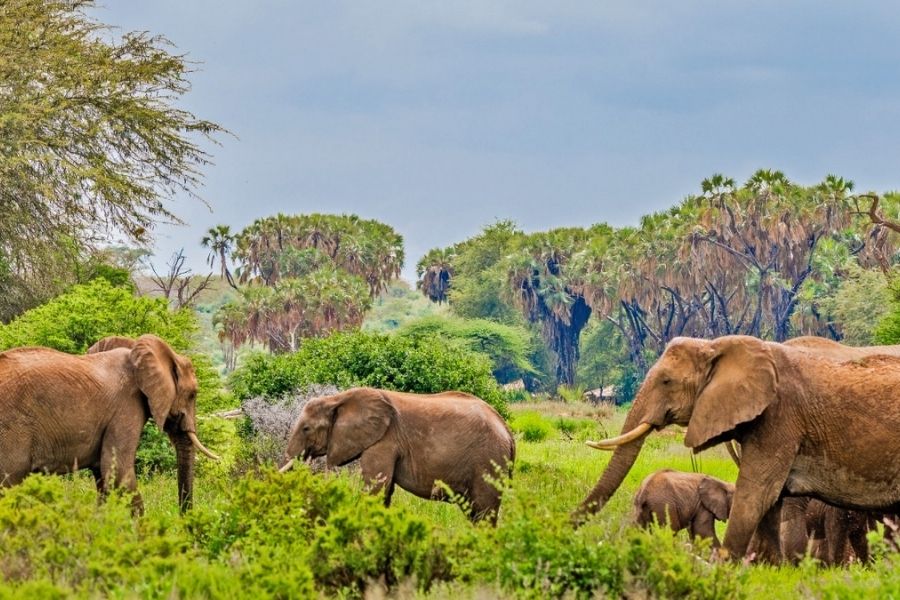
Elephants range across a wide spectrum of habitats from the hot coastlands to the cold moorlands of the Aberdares & Mt. Kenya at 3600M. Infact, very few other animals have this range. Elephants are found in most of the parks. However, herds of 100 or more can be found in Meru, Amboseli and sometimes in Samburu. Despite their great size, elephants are remarkably specific when left on their own
The need to maintain its vast bulk (some 150 – 200 kg of forage a day) keeps an elephant on the move and constantly active – even at night the incessant search for food continues. It is this restlessness which makes elephant watch more rewarding.
The wanton destruction of the rhino throughout the whole of Arica, has severely reduced the Rhino population, to the point where it has become very necessary to relocate most of the remaining few into safe sanctuaries.
Nairobi National Park, Lake Nakuru National Park and Tsavo National Parks (East & West) all hold many Rhinos although in the Masai Mara and in the forests of the Aberdares and Mount Kenya it is still possible to find Rhino which have not been translocated. Few visitors leave Kenya without sight of these shambling, unpredictable monsters. The best time to see them is in the early morning for in the heat of the day, they return to thick bush as their heat absorption capacity is poor.
Giraffe too roam the Savannah with little competition for the tender leaves of the Acacia trees which are their principle food. The reticulated species, found north of the Equator, must be one of Kenya’s most striking animals. The lakes, swamps, rivers and riverine forest supports their own specialized wildlife.
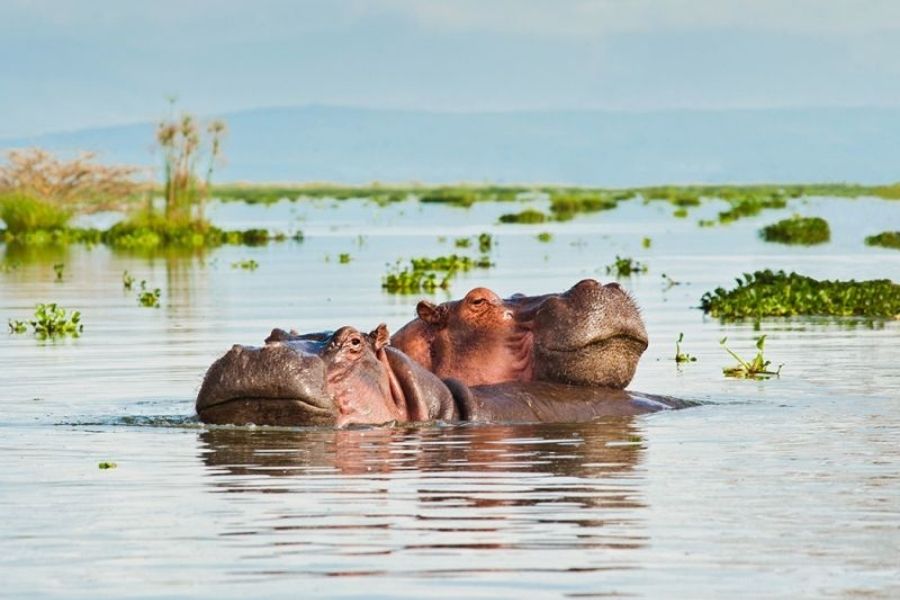
Hippo of course irritable and cantankerous, share their habitat with the little loved crocodiles. The largest concentration of crocodile anywhere is to be found in Like Turkana and at Sibiloi Park. The numbers are especially great with as many as 50 – 60 crocodiles per kilometer of beach. Crocodiles feeds mostly on fish of which our rivers and lakes holds considerable variety. The Nile perch found in Lake Victoria and Turkana is the most notable species reaching enormous proportions - 50 kg specimens are quite common..
The cape (or African) buffalo, judged by most hunters to be the most dangerous of the big game,inhabits grassland where there is preferably thick cover and swamp in which it lies up, but like the elephant it is also adapted to life in dense and cold forest. Yet ferocity is clearly not the mark of buffalo in groups. Their herds which can be numbered in many hundreds are quite timid.
Hippo of course irritable and cantankerous, share their habitat with the little loved crocodiles. The largest concentration of crocodile anywhere is to be found in Like Turkana and at Sibiloi Park. The numbers are especially great with as many as 50 – 60 crocodiles per kilometer of beach. Crocodiles feeds mostly on fish of which our rivers and lakes holds considerable variety. The Nile perch found in Lake Victoria and Turkana is the most notable species reaching enormous proportions - 50 kg specimens are quite common..
This is not the place to describe the wealth of wildlife in any detail. Suffice to glimpse this great pageant in anticipation of a visit. In summary it shows that the major parks (Tsavo, Amboseli, Masai Mara, Samburu and Meru) all features not less than 50 species, but there are other areas such as Maralal and the Tana river primate reserve where there are as many species but less abundance.